Call for Abstracts: Mapping Public Space through Participatory Data Narratives and Cartographies - (STS Conference, Milano)

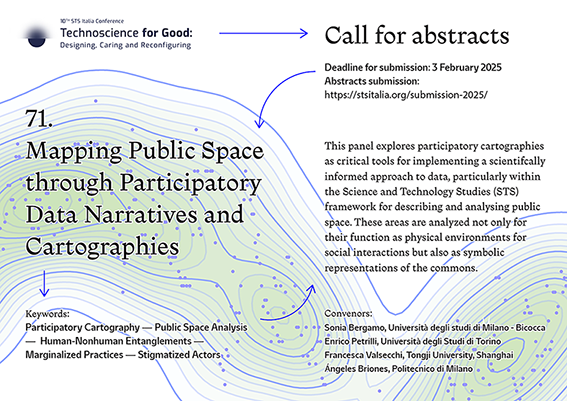
Hello everyone, best wishes for the new year. We are excited to announce the Call for Abstracts for the upcoming 10th STS Italia Conference “Technoscience for Good: Designing, Caring and Reconfiguring” which will be held on 11-13 June 2025 at the Politecnico di Milano, Milan (Italy) – ( https://stsitalia.org/news/10th-sts-italia-conference-technoscience-for-good... ). In particular, we invite you to submit an abstract to our panel #71: *Mapping Public Space through Participatory Data Narratives and Cartographies* (Convenors: Sonia Bergamo, Enrico Petrilli, Francesca Valsecchi, and Ángeles Briones). (further details here: https://stsitalia.org/wp-content/uploads/2024/12/71.Mapping-Public-Space-thr... ). This panel explores participatory cartographies as critical tools for implementing a scientifically informed approach to data, particularly within the Science and Technology Studies (STS) framework for describing and analysing public space. These areas are analyzed not only for their function as physical environments for social interactions but also as symbolic representations of the commons. Participatory cartography approach emphasizes the involvement of local communities in the creation and use of maps, including the data collection and the construction of mapping narratives. Such an approach provides a framework for STS to build upon the instrument of STS while incorporating the social sciences’ critical perspectives, fostering an inclusive, equitable, and context-sensitive understanding of spatial data. Participatory cartography challenges traditional divides between researchers and subjects by empowering communities and recognizing their unique knowledge and experiences. It advances representations that extend beyond mere geographical metrics, leveraging the combined strengths of quantitative and qualitative data for comprehensive, systemic insights. In doing so, it enhances the relevance and accuracy of spatial data, supporting a richer portrayal of public spaces. Participatory cartography significantly supports STS data management. It integrates local knowledge and community engagement throughout data collection and analysis. This approach champions open access to data, data empowerment, and community ownership, positioning data as a tool for informed public policymaking. The goal of the panel is to explore and document the complex entanglements within public spaces, examining both human and non-human agencies in the collective knowledge domain. Special emphasis will be given to marginalized practices and “stigmatized actors” (such as unhoused individuals, youth, non-human species, and non-normative social practices) often sidelined in policy discourse. Employing a diffractive methodology, we seek contributions that incorporate both human and non-human actors - including psychoactive substances, informal urban infrastructures, agents of gray economies, and ecological entities - offering nuanced perspectives on the environments they shape. Presentations are encouraged to promote epistemic justice by reimagining public spaces as inclusive, adaptive, and creative environments that address diverse needs across human and non-human domains. Abstracts (500 words max) are due by February 3, 2025. Further information about the submission process and key deadlines can be found here: https://stsitalia.org/call-for-abstracts/ We look forward to receiving your contributions and seeing you in Milano! Best Wishes Sonia Bergamo, Università degli studi di Milano - Bicocca Enrico Petrilli, Università degli Studi di Torino Francesca Valsecchi, Tongji University, Shanghai Ángeles Briones, Politecnico di Milano -- -- Ángeles Briones R. Ph.D. in Design @ Politecnico di Milano - DensityDesign Research Lab, Dipartimento di Design www.densitydesign.org -- -- Ángeles Briones R. Ph.D. in Design @ Politecnico di Milano - DensityDesign Research Lab, Dipartimento di Design www.densitydesign.org
participants (1)
-
 angeles briones