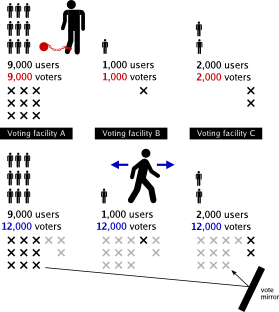
We're seeking collaborators for a Knight News Challenge proposal. This year's challenge is, "How might we improve the way citizens and governments interact?" https://www.newschallenge.org/ The submission deadline is March 18. Below is a tentative draft of our proposal. We haven't finalized it yet. If you're a provider of online voting services and wish to join in this proposal, please contact one of us (see provider list in description below). Aside from technical providers, we might also need organizational support (in part because there's financing if we win). PROJECT TITLE Free-range voting MAIN IMAGE http://zelea.com/project/outcast/vomir.png DESCRIPTION This is a proposal to apply the technology of vote mirroring in order to forestall the formation of a monopoly in primary voting services. Innovations in primary voting are beginning to improve the way citizens and governments interact. New methods of continuous, online voting will soon enable citizens to form and express their opinions well in advance of government decisions. To ensure that these developments offer enhancements to our political freedom, rather than reductions, we must maintain a level playing field among the competing technical providers; both the ability of the citizen to express herself clearly and effectively, and the ability of the technician to supply the necessary innovations, depend on the citizen's unrestricted freedom in choosing a technical provider. You might think that opening up the source code of a voting facility would be sufficient to ensure that the facility itself stays free and open, but that is not true. Voting is prone to network effects. It's like a telephone service in this regard. If I plug my telephone into a different network than everyone else is using, then it isn't going to work. Having a copy of the source code won't help. Unless something is done to address and tame the broader network effects, then online voters (like telephone customers before them) will become locked into the services of a dominant provider. The solution proposed here is vote mirroring. Votes cast at facility A are mirrored at facilities B, C, and so forth. This involves copying each vote and translating it from the format of the source facility (A) to that of the mirroring facility (B, C, etc.). Voting methods may differ hugely and the translation may therefore entail a degree of information loss, making for an imperfect image. Such imperfections cannot invalidate the overall technique, however, because a best effort at an image is always a better reflection of reality than no image at all. The upshot is that each facility now gets all the votes and can show the truest possible picture of the overall results. It no longer matters where I cast my own vote, because it shows up everywhere regardless. So I can range freely across all the available facilities and settle on whichever best suits my personal needs and preferences. Never again can I be trapped by a particular provider. This proposal will initially implement free-range voting in: Agora Voting http://agoravoting.com/ Libre software voting platform, through the small company Wadobo, which has collaborated very actively in its development. Contact: Eduardo Robles Elvira. Votorola http://zelea.com/project/votorola/home.html Social software in support of public autonomy. Contact: Michael Allan, +1 416-699-9528, http://zelea.com - if you're a technical provider of voting facilities and wish to join us in this proposal, please contact one of us - Together we plan to build a lightweight mirroring network to loosely interconnect our voting facilities. We'll begin with voting forms that are fully public; those are the simplest to handle and they allow for unrestricted technical freedom among providers. We'll work out the problems and gain experience with the technology. An immediate benefit will be to reduce the expectation of network effects that has long poisoned relations among providers and hampered their development work. Small projects will no longer be forced to devote scarce resources to attempts at tipping an unstable balance in their own favour. Instead, we may expect an improvement in the professional climate of the field and an increase in its attractiveness to talent, and other resources. Along the way, we'll document the techniques, patterns and protocols that work for us. These will be the first entries in what we hope later evolves into a catalogue of lightweight standards that others may optionally apply; both to hook into the mirroring network itself, and also to interoperate with other facilities related to voting. We'll avoid developing standards that are mandatory for mirroring, however, because that might restrict technical freedom, impair innovation, and degrade the mirroring network into a technical monopoly of its own. Instead, we'll keep the mirroring network forever open to all possible methods, forms and implementations of voting. WHAT IS YOUR PROJECT? (1 sentence max) To apply the technology of vote mirroring in order to forestall the formation of an online monopoly in the provision of primary voting services, improve the professional climate among providers, and keep the field open as a source of innovation for improving the way citizens and governments iteract. LINKS http://zelea.com/w/User:ThomasvonderElbe_GmxDe/Vote_mirroring http://zelea.com/w/User_talk:ThomasvonderElbe_GmxDe/Vote_mirroring http://zelea.com/w/User:Mike-ZeleaCom/Vote_mirroring_as_a_counter-monopoly_m... OTHER IMAGE http://zelea.com/project/outcast/voteFree.png ACKNOWLEDGEMENT Vote mirroring is the invention of Thomas von der Elbe. See: http://mail.zelea.com/list/votorola/2009-December/000215.html The latest copy of this draft is at: http://metagovernment.org/wiki/Knight_News_Challenge/Free-range_voting -- Michael Allan Toronto, +1 416-699-9528 http://zelea.com/